
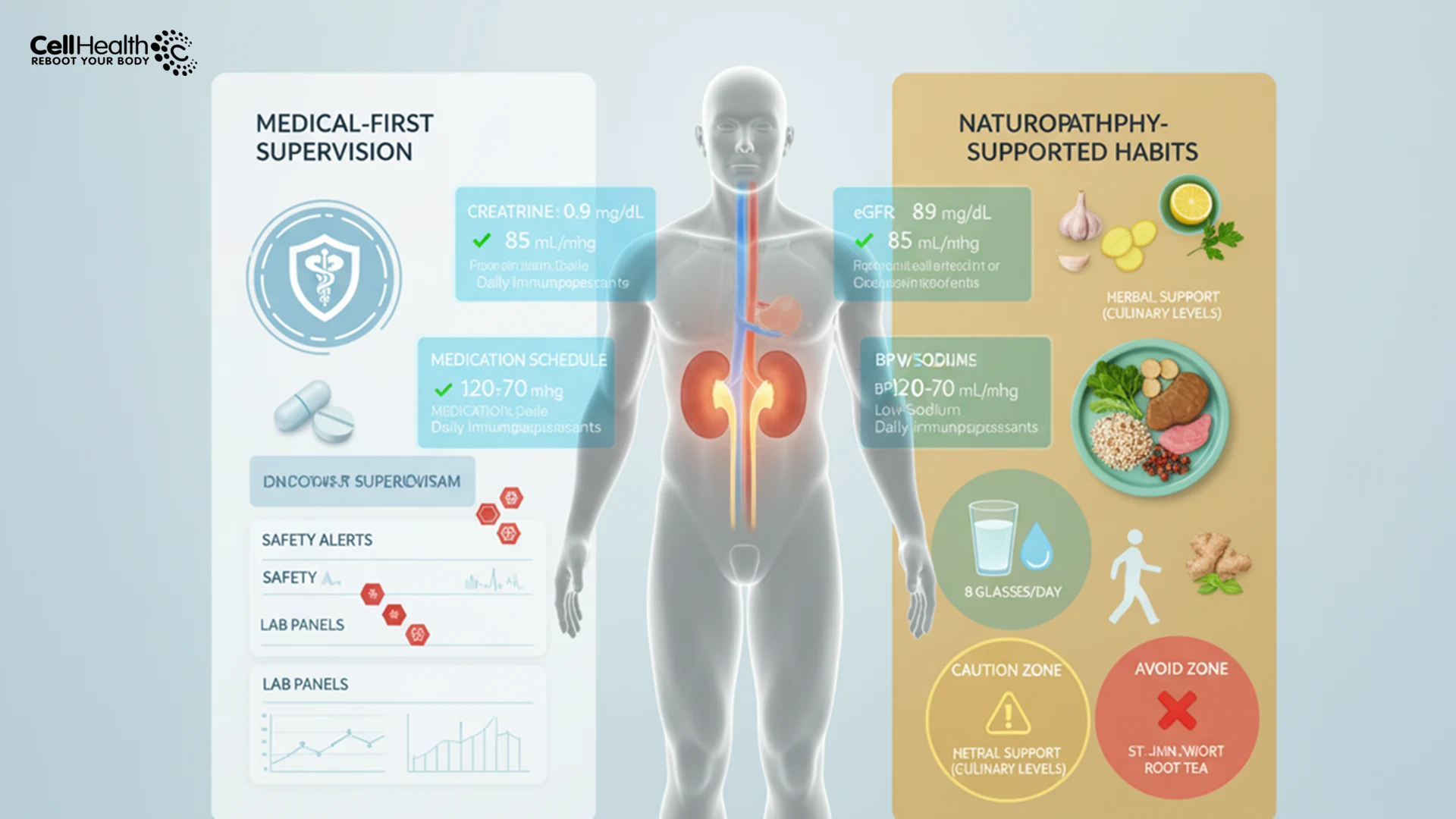
A polished, clinic-style article with safety rules, a phased plan, and a clear role for Cellhealth.
In brief: When your transplant team leads care, a focused plan for kidney transplant recovery naturopathy can reduce day-to-day strain, steady circulation, and rebuild protective habits. It never replaces immunosuppressant’s; rather, it turns natural kidney transplant recovery into a calm, repeatable routine.
First: safety rules you must keep
- Medication first, always. Immunosuppressants and labs (creatinine, eGFR, tacrolimus/cyclosporine, electrolytes, BP) dictate every decision.
- Red-flag symptoms = urgent call. Fever, new swelling, breathlessness, chest or flank pain, blood in urine, or rapid weight gain (≥1–2 kg in 48 hours).
- Herbs only with approval. Post-op drug–herb interactions are common; “natural” does not mean harmless after a kidney transplant.
Therefore, think “doctor-led, habit-powered.”
The 3-Phase Recovery Plan (professional and realistic)
1) Stabilize (Days 1–10)
Goal: reduce load and keep flow steady.
- Timed hydration: one small glass on waking, then a glass every 2–3 hours; avoid late-night chugging. Consequently, urine flow improves without disturbing sleep.
- Plate design: half vegetables, a palm of lean protein, fiber-rich carbs, plus olive oil or nuts. Moreover, keep sodium modest and read labels.
- Micro-movement: walk 10 minutes after two meals; add gentle mobility in the afternoon.
- Sleep window: lights down 60 minutes before bed; box breathing (4-4-4-4) twice daily.
2) Strengthen (Weeks 2–6)
Goal: support blood pressure, glucose, and stamina.
- Pair carbohydrates with protein to flatten spikes; log energy and swelling.
- Add two brief strength sessions weekly (15–20 minutes). As a result, circulation improves and daytime energy steadies.
- If cleared, consider herbal support for kidney transplant one item at a time (see matrix), with a 5–7-day observation window.
3) Sustain (Week 7+)
Goal: make gains durable.
- Batch-cook two low-sodium meals every Sunday.
- Keep hydration cadence; add a third short walk on busy days.
- Review your dashboard with the clinic; adjust slowly. Thus, routines stick and setbacks shrink.
Botanicals: a transplant-safe “traffic light” guide
Introduce only with explicit approval; start low, go slow; document dose, timing, and effect.
Generally OK at culinary levels (if your clinician agrees): garlic, parsley, ginger, lemon for flavor.
Caution with monitoring: dandelion leaf tea (½ cup at midday, 10–15-min steep), nettle infusion (½ cup morning, 20–30-min steep). Minerals and fluids can shift; therefore, labs and BP must be watched.
Avoid post-transplant: St. John’s wort (lowers tacrolimus/cyclosporine), echinacea/astragalus (“immune-boosting”), and grapefruit/juice (raises immunosuppressant levels).
This precision reflects evidence-minded naturopathy after kidney transplant, supportive, careful, and reversible.
A day that works (simple, repeatable)
Morning – Water → meds on schedule → protein + greens breakfast → 5–10-minute walk. If approved, sip ½ cup nettle infusion.
Mid-day – Half-plate vegetables; citrus or berries; 10-minute walk; one glass of water.
Afternoon – Five minutes of mobility; brief rest if fatigue rises. If cleared, ½ cup dandelion tea on desk days.
Evening – Cook with herbs and lemon instead of heavy salt; screens off early; box breathing; consistent bedtime.
Meanwhile, keep portions moderate and spread protein across meals; consistency beats intensity.
What to track (data that guides decisions)
- Blood pressure: morning and evening, same posture.
- Daily weight trend: watch fast rises (possible fluid).
- Urine color/volume: aim for pale straw by mid-afternoon; note sudden drops.
- Swelling & energy: ankles, eyelids, mid-afternoon dip.
- Adherence score (0–10): hydration cadence, sodium control, post-meal walks, sleep window.
Consequently, your team can adjust with confidence rather than guesswork.
Cellhealth’s role (brand-light, results-heavy)
Cellhealth acts as an adjunct to your transplant team—never a replacement. The service operationalizes your plan: hydration timing matched to your schedule, sodium targets and grocery swaps, protein distribution, and a one-at-a-time, interaction-screened approach to herbal support for kidney transplant. In addition, brief follow-ups review your dashboard, escalate red flags, and refine habits so post-transplant kidney health support remains safe and measurable.
FAQ (fast, honest answers)
- Does “kidney transplant recovery naturopathy” mean lots of supplements?
No. Foundations lead; supplements follow—and only if cleared.
- Which single habit moves the needle first?
Sodium control plus 10-minute post-meal walks. Consequently, pressure, flow, and energy usually improve together.
Bottom line
With clinicians setting the guardrails, habit systems do the heavy lifting. Therefore, use the 3-Phase Plan, track relentlessly, and treat botanicals like prescriptions. Done this way, natural kidney transplant recovery becomes practical, while naturopathy after kidney transplant supports (not competes with) your medical care.